Manuel’s Pacheco Report
Los pacientes del doctor GarcíaManuel’s Pacheco Report is a meticulously assembled record of Nazi fugitives and the network that helped them evade accountability, built from Manuel Arroyo Benítez’s undercover work in Spain and Argentina. More than four hundred typed pages, accompanied by almost a hundred photographs, it gathers aliases and authentic names, addresses, dates, routes, identities, and crimes into evidence that could have enabled the arrest of scores of war criminals. Its decisive significance lies in the distance between what the dossier makes knowable and what powerful governments choose to do: Manuel preserves a copy because the official response has made action seem futile, yet that same record remains an answer to the destruction and disappearance of evidence around him.
Compilation and Physical Form
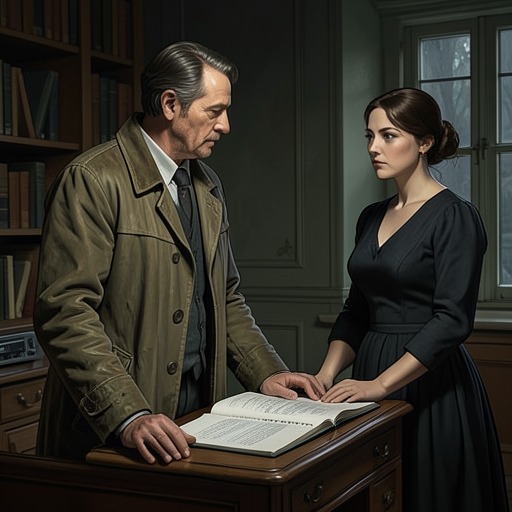
The report comes into view years after Manuel has written it, when he places a thick ring binder on the café bench beside him—the seat he likes because it faces the door—and pushes it across the table to Guillermo García Medina. He explains that it is a copy of the document he composed in Buenos Aires. The opening portion covers material Guillermo already knows, with further discoveries added; from approximately page two hundred onward, it records what Manuel learned in Argentina. The report thus joins successive phases of his investigation rather than documenting only one city or episode.
The binder contains more than four hundred single-spaced typewritten pages and close to a hundred photographs. The images show building façades and interiors, documents, and, above all, people: many men and some women. Its contents extend beyond names to false and genuine identities, private and professional addresses, dates, places, sea and air routes, and even the number of the flight on which Manuel himself arrived. The scale and specificity matter: Manuel believes that, had the authorities wished to act, they could have used the dossier to arrest a hundred war criminals in Madrid and Buenos Aires in a single night.
Evidence Gathered Through Infiltration
The report’s information came from Manuel’s access to Clara Stauffer’s circle. In the summer of 1945, Stauffer had altered her home at Galileo 14, installing an office with a new telephone line, hiring two secretaries, and filling new cupboards with men’s clothes in different sizes and shoes in every size. The visitors changed as well. Alongside familiar guests came thin, exhausted men who arrived at all hours. Sole Ruiz recognized them as fugitives: some had escaped European prisons and crossed the Pyrenees, while others had been released from Nanclares.
At Galileo 14, the men received food and clean clothes, and the organization apparently arranged places for them to stay and perhaps work. They did not sleep at Stauffer’s house, but often returned to the office looking better than when they had arrived. Sole noticed that none spoke Spanish. Her suspicions sharpened when a Spanish conscript began bringing sealed envelopes, often bearing the letterheads of Madrid parishes. After one envelope was left open, she found a baptismal record with German names and a date of birth in 1907. That traffic continued until Sole fled Spain. Shortly beforehand, she heard a secretary identify a visitor as Jean-Jules Lecomte, a name that helped connect the household’s routine to a specific fugitive.
Sole’s observations supplied a lead, not proof. Meg Williams recognized Lecomte as a committed Nazi who belonged both to the Rex Party and the SS and had served as burgomaster of Chimay during the occupation. The evidence gathered through Stauffer’s household could point investigators toward identities and methods, but Manuel and his associates still needed to verify the information and establish the fugitives’ destinations. The report is the later product of that effort to turn fragmentary sightings, documents, and connections into a usable account.
A Network the Authorities Would Not Pursue
Manuel’s findings helped Meg persuade Congressman Sal Burnstein that the Stauffer operation was not merely a collection of rumors. Burnstein had been investigating Nazi escape routes without finding firm evidence of a stable organization; the information from Stauffer’s network suggested that such an organization existed. But evidence adequate to persuade investigators was not yet enough to present a case before the United Nations or pressure the United States government. The investigators also needed to confirm that Lecomte and Horst Fuldner were the men they were believed to be, establish the identities of Stauffer’s Argentine visitors, and show that her work extended beyond feeding and clothing German fugitives.
Their working theory was that Stauffer’s operation cooperated with Juan Perón’s government. Argentina was a destination for fugitives seeking to evade international tribunals, and the Perón government was sending Spain shipments of grain and frozen meat despite the blockade. Stauffer, the investigators suspected, supplied Spanish documentation for escapees using baptismal certificates obtained through friendly parish priests and her contacts in the state administration. These were consequential hypotheses, not conclusions established by the evidence then available. An infiltrator was needed to confirm the route and expose the network’s connections. Manuel’s work, and the report that records what he learned, answer that demand for a fuller evidentiary chain.
The dossier also connected suspected escape routes to the concealed Nazi property and records in Madrid. Manuel believed that shipments Guillermo had agreed to oversee would contain art looted from museums and Jewish owners in occupied territories, valuable jewels and antiquities, and possibly gold, silver, or foreign currency from the vanished Nazi treasury. He recalled that on 18 July 1947, during his first visit to Cercedilla, Stauffer had intended to introduce Guillermo to a friend whose name sounded like Ban or Bam. If it ended in an m, Manuel reasoned, she might mean Hans Lazar, known to intimates as Bam. Lazar was the only person connected with the matter whom the Allied Control Council had found at Hitler’s embassy in Madrid.
The Allies suspected that Lazar had secretly moved the embassy’s and ambassador’s residence’s treasures to a hiding place they had searched for in vain, along with documents from an unseen archive. Spain had authorized his repatriation in February 1946, but the former diplomat entered Clínica Ruber with severe appendicitis on the day before his flight to Germany. His appendix was removed, yet his pursuers suspected the operation had provided a pretext to avoid repatriation; after that, he disappeared from their view. Manuel’s report and the information behind it therefore concern not only the escape of people, but also the possible disappearance of stolen property and records that might have revealed what had happened.
Preservation, Refusal, and Aftermath
Manuel says that the authorities did not act on the report. They praised his work, but the dossier did not lead to the arrests he believed it could have made possible. The CIA tried to recruit him. He refused, and afterward was frightened enough to regret, for a time, keeping a copy. He had not sent it to Pablo de Azcárate either. The blue binder remained with him not because he thought it would be useful, but because the possibility that the original might end up in a Washington office’s shredder was intolerable.
After marrying Simona, Manuel bought a safe and installed it himself in a wall; the copy remained there for years. In 1955, when Perón fell and the Nazis in Argentina seemed less protected, he was glad he had not destroyed it. The report’s survival is thus tied to a change in political circumstances, but the change does not erase the earlier failure to use it. Manuel later considered sending it to Simon Wiesenthal or another Nazi hunter. He had a wife and young children, however, and he believed that the fugitives and their associates, who knew him, could locate him if he exposed them. He also doubted that arrests made on the strength of the report would change Spain’s protection of its own political arrangements.
That judgment comes into sharp focus when Manuel finally hands the copy to Guillermo. As Guillermo turns its pages, the names, dates, underlinings, and lists of crimes place the murder of Adrián Gallardo beside the mass atrocities of Dachau, Gusen, Birkenau, Jasenovac, Mauthausen, Auschwitz, and Klooga. For Guillermo, Adrián is the man he killed to save his own life and Manuel’s, a personal victim who still haunts him. In the dossier, that death is only one among many. The contrast exposes the report’s double function: it preserves an extensive record of crimes, yet its accumulation of names can also reduce even an intimate act of violence to a single entry in a catalogue of mass suffering.
Manuel explains that he kept the copy because publishing it would have remained dangerous, especially once he had a family. He had struggled to detach himself from the Nazis in Buenos Aires, and people there knew him. He also believed that even if the report helped bring some fugitives to justice, nothing would happen in Spain under Francisco Franco. His bitterness is not presented as a claim that the evidence was weak; the dossier’s detail says otherwise. It is his conclusion about the institutions that received, praised, or might have acted on it. The report survives as both an archive of what he uncovered and a record of why he eventually stopped believing that disclosure would secure justice for the people abandoned by the international powers.